Memory | article 3
Tasting, a matter of memory
- 20.15.2021
- Complementary views
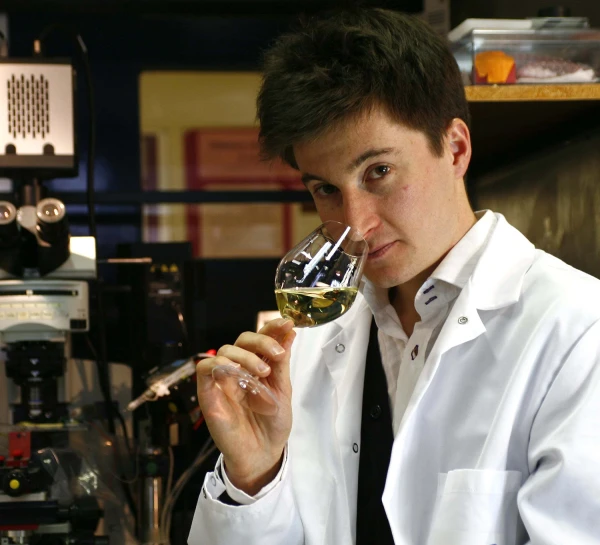
How does our memory work when it comes to tasting? We asked neurobiologist Gabriel Lepousez, a researcher for the “Perception and Memory” Unit at the Pasteur Institute and co-founder of the Ecole du Nez.
What is the role of memory in tasting?
Memory is fundamental in tasting. Without it, each sip tasted would be a novelty.
When you taste a wine, your memory is immediately required to carry out a recognition task. Every time I smell an aroma, my brain immediately gets to work so as to try to recognise it. That is to say, to “know again”: I will compare the information that comes from my sensory organs with the information that I have stored in my memory. In the tasting profession, our past experience engraved in our memory allows us to better analyse the present and anticipate the future.
Neuroscience has shown that emotions and memory are intertwined. What is their link?
Emotions, whether positive or negative, are extremely powerful in engraving a memory. The more emotionally charged a fact is, the more it will be remembered. For example, everyone remembers what they were doing when they heard about the events of 11 September 2001, whereas we can’t remember what we were doing the day before. In other words, a memory will be all the more lasting if it is associated with a strong emotion.
As far as olfactory information is concerned, this is even truer, because the sense of smell has the particularity of activating both the memory and the emotional centres in the brain. This explains why smells are so likely to bring back memories: they trigger emotions, and emotions are related to powerful and persistent memories.
This is the strength of the olfactory system: it awakens both the rational and emotional systems.
"When you taste a wine, your memory is immediately required to carry out a recognition task."
How does this translate into wine tasting?
There is a paradox in olfactory perception: even before we can identify and describe an odour, we are able to tell whether we like it or not. Olfactory information is sent directly to and processed by the emotional centre, whilst at the same time following a slower pathway to our olfactory memory centre.
Between these two analytical paths, it is the emotional path that is privileged in a young taster when they taste a wine: they react in a purely hedonic way, making a value-based judgement by expressing “I like it or I don’t like it”. However, paradoxically, they are unable to describe precisely what they like. Incapable of verbalising their preferences, they will not be able to share their thoughts with others.
Emotion is therefore an important tool when it comes to learning to taste. However, the quality of a wine cannot be reduced to the single emotion of pleasure. Emotion must be the support used to better store a wine’s sensory dimensions in our memory. Especially as, in this task of analysing and recognising a wine, the most difficult thing is not to acquire and store elements in our memory, but to find them in our memory and to mobilise them.
Is this what distinguishes an expert from a novice?
Yes, it is. The strength of the expert is the richness of their memory and their ability to recall this memory. Indeed, after years of expertise, their brain has built a rich, precise and organised memory, as well as an ability to activate the two paths that connect to the memory: that of emotions and that of analysis. By relying on these two ways of thinking, they will multiply the means of accessing their memory and the associations established: I have already encountered this smell and it reminds me of this situation, this place, this person… this is the recall mechanism.
As soon as they taste, the expert compares: they use their memory and rely in particular on the emotions they feels to connect the elements together and identify what makes up a wine.
Some experts sometimes prefer a purely analytical approach, highlighting only the analytical characteristics of what they are tasting while putting aside the subjective emotion that tasting brings them.
Thus would the expert better share their tasting experience?
It’s more complicated than that because sharing wine vocabulary requires the establishment of a common language and a common memory. When it comes to recalling wines, we associate tastes or smells with words, with descriptions. But how can we be sure that a given description evokes the same thing, the same memory in different tasters who each have their own experience, culture and background?
Humans have 400 basic olfactory sensors. This is staggering in terms of coding capacity and discrimination! However, we cannot have 400 words to describe each of these olfactory dimensions. Whilst we cannot be perfectly objective, we can try to relate what we smell to elements already recorded in our brain and which serve as a reference unit.
The problem is that the frame of reference is not the same for everyone or for every culture. During a tasting session in Hong Kong, I came up against this problem. I realised that what I clearly identified as a green pepper smell was associated, by the local participants, with ginseng root. Both have common chemical components that evoke the same smell. But the Asian tasters were not familiar with pepper, as I am not with ginseng, so our brains did not make the same association. This is an example of the limits of wine description: that day, European or Asian, our associative memory was not the same and our analysis diverged, we did not speak the same aromatic language.
"Humans have 400 basic olfactory sensors.
This is staggering in terms of coding capacity and discrimination!"
What are the keys to improving one’s memory and one’s tasting skills?
The challenge is not to record exact references and data to memory, but to be able to recall them, i.e. to accurately use what you have learned to better analyse the present situation.
Neuro-oenology” shows that the art of tasting is a task that requires an essential organ: the brain. A novice taster has not yet organised and optimised their memory, which is partly why they have difficulty associating smells with memories. The expert, on the other hand, has the ability to recall a memorised element with precision, to distinguish it correctly from another nearby element and to verbalise it. It is a question of training.
You have to feed your memory by repeating tastings and without neglecting any detail or information. Like any organ, it can be trained and optimised. The more you taste, the more the access paths to the memory will be optimised and the easier it will be to find the connection to a given memory. The brain will also multiply the access routes to the memory by creating multisensory associations: emotional, olfactory, visual, gustatory, tactile, contextual aspects… Thus it will use these associations to better retrieve all the information stored for a given wine.
Why do we have to taste the same wine several times to better memorise it?
One of the major neuroscience discoveries of the last ten years is to have understood the mechanisms at work between the acquisition of knowledge and its recall, during the so-called consolidation phase. Consolidating memory means repeating the recall of information so as to make the memory effective in the long term. This process also takes place during sleep: while the sensory receptors are at rest, the brain is very active and repeats the information accumulated during the day to consolidate the memory.
This is therefore an essential part of the tasting process. The more you “muscle” your memory through training, the better your performance will be. This is an important element of confidence in one’s tasting abilities and, indirectly, another way of gaining pleasure and creating positive emotions during tasting.
Follow us
@chateautroplongmondot